
How NGOs Can Automate Donor Reporting
Stop manually updating spreadsheets for donors.
The Core Challenge
For many NGOs across East Africa, donor reporting remains a manual, soul-crushing cycle of copy-pasting data from field notes into fragmented Excel spreadsheets. This reliance on manual entry is more than just an administrative burden; it is a bottleneck that traps your best talent behind desks, tethered to version-control nightmares rather than focusing on the impact programs you were founded to deliver. When your data is siloed and manual, your reporting is always reactive, error-prone, and weeks behind the reality on the ground.
Why It Matters
The cost of inaction is measured in lost momentum and missed funding opportunities. In a competitive global landscape, donors are increasingly demanding transparency and real-time insights. If your team spends 40% of their time chasing data, you are essentially paying for high-level expertise to perform low-level data entry. Furthermore, delayed or inaccurate reporting erodes donor trust, turning a potential multi-year partnership into a one-off transaction. Inefficiency is not just a nuisance—it is a direct threat to your organization’s scalability and long-term financial sustainability.
The Practical Solution
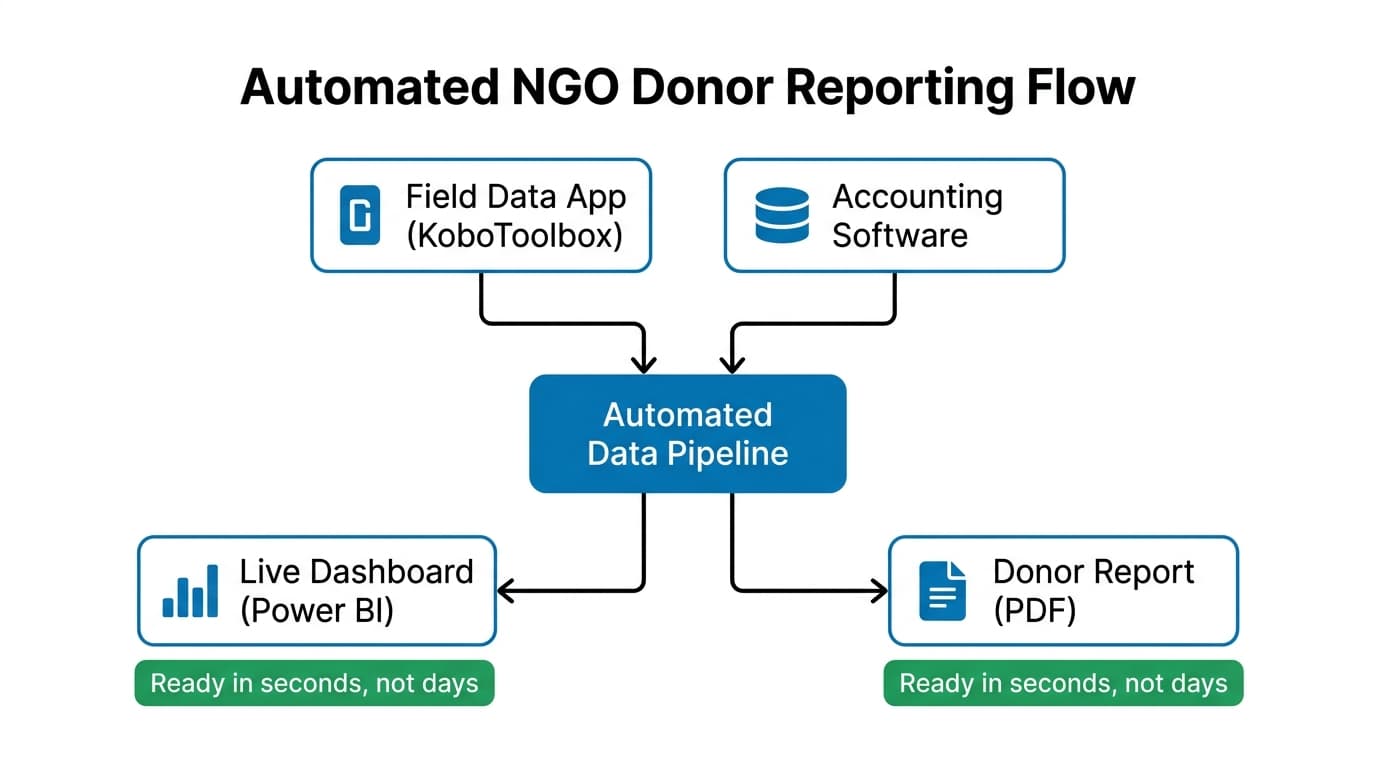
Automating donor reporting is not about building complex software; it is about creating a "single source of truth." By integrating your field data collection tools (like ODK or KoboToolbox) directly with a central cloud-based dashboard (such as Power BI or Tableau), you can visualize progress in real-time. This automated pipeline pulls data from the field, cleans it, and populates pre-configured donor templates instantly. The result is a system where your impact metrics are always ready for export, requiring only a final human review rather than days of manual consolidation.
Key Takeaways
- Shift from manual data entry to automated data pipelines to reclaim hundreds of staff hours annually.
- Replace static, error-prone spreadsheets with live, cloud-based dashboards that donors can trust.
- Strengthen donor relationships by providing transparent, real-time reporting that sets your organization apart as a data-driven leader.