
Designing Dashboards That People Actually Use
Avoiding the trap of over-complicated reporting.
The Core Challenge
In many boardrooms across East Africa, we face a paradox: we are drowning in data but starving for insights. Executives often fall into the trap of commissioning "all-in-one" dashboards that attempt to visualize every metric under the sun. The result is a cluttered, overwhelming interface that eventually gathers digital dust. When a dashboard tries to track everything, it ends up communicating nothing, forcing leaders to rely on gut instinct because the data is too noisy to interpret.
Why It Matters
The cost of a bloated dashboard is far higher than the software subscription. It represents a "blind spot" in your decision-making process. When your team spends hours deciphering complex charts instead of acting on clear trends, agility suffers. In a fast-paced market environment, this friction leads to delayed pivots, missed growth opportunities, and wasted operational budget. If your dashboard doesn't prompt an immediate, confident decision, it isn't an asset—it’s an expensive distraction.
The Practical Solution
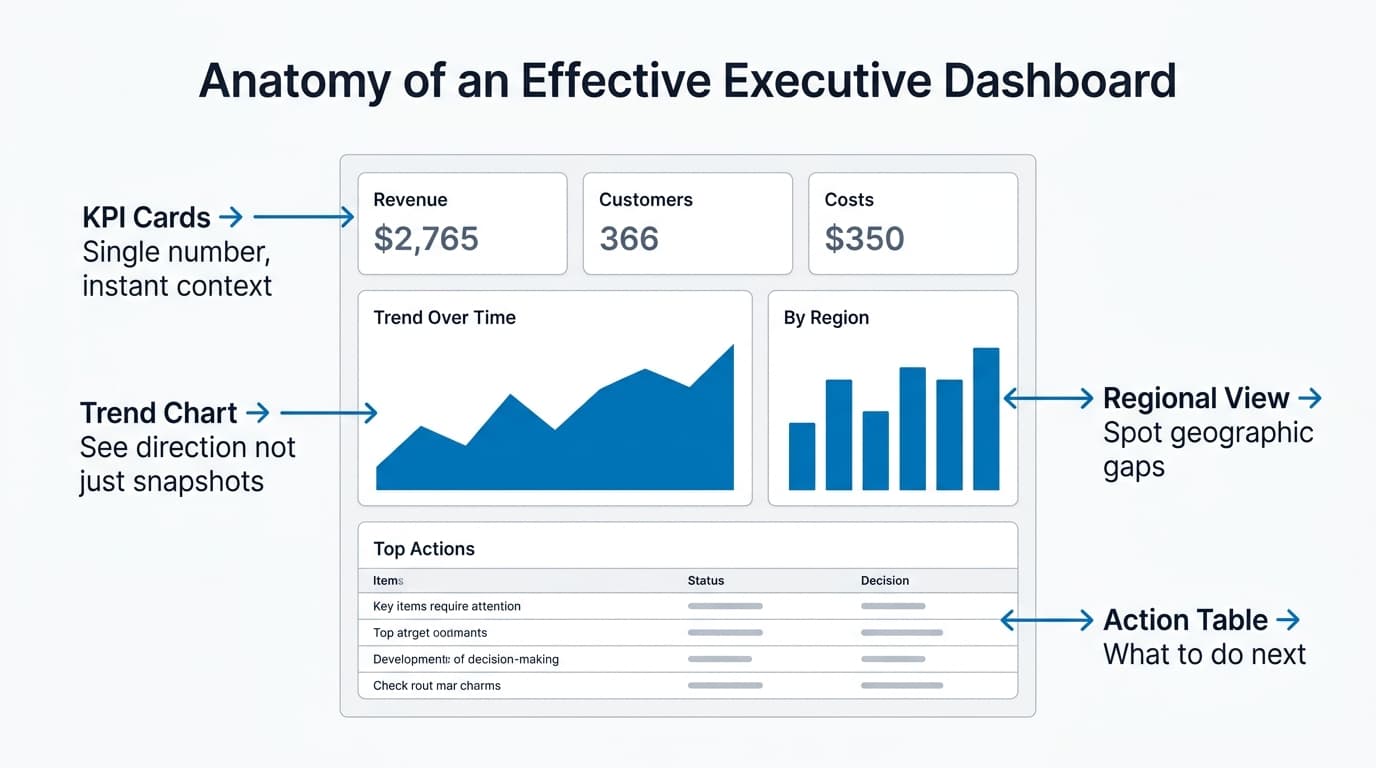
The secret to a high-adoption dashboard is ruthless prioritization: design for the user’s specific role, not the system’s capacity. Start by asking, "What is the one decision this person needs to make today?" Limit your view to three to five Key Performance Indicators (KPIs) that track outcomes, not just activities. Use intuitive visuals—like simple trend lines or traffic-light indicators—that tell a story at a glance. If a metric doesn't trigger a "keep," "fix," or "invest" action, remove it. Simplicity is not just a design choice; it is a strategic advantage.
Key Takeaways
- Focus on outcomes over volume: Display only the metrics that directly influence your strategic goals.
- Prioritize actionability: If the data doesn't tell your team what to do next, it is just noise.
- Design for the user: Customize views so that every stakeholder sees only what is relevant to their specific responsibilities.